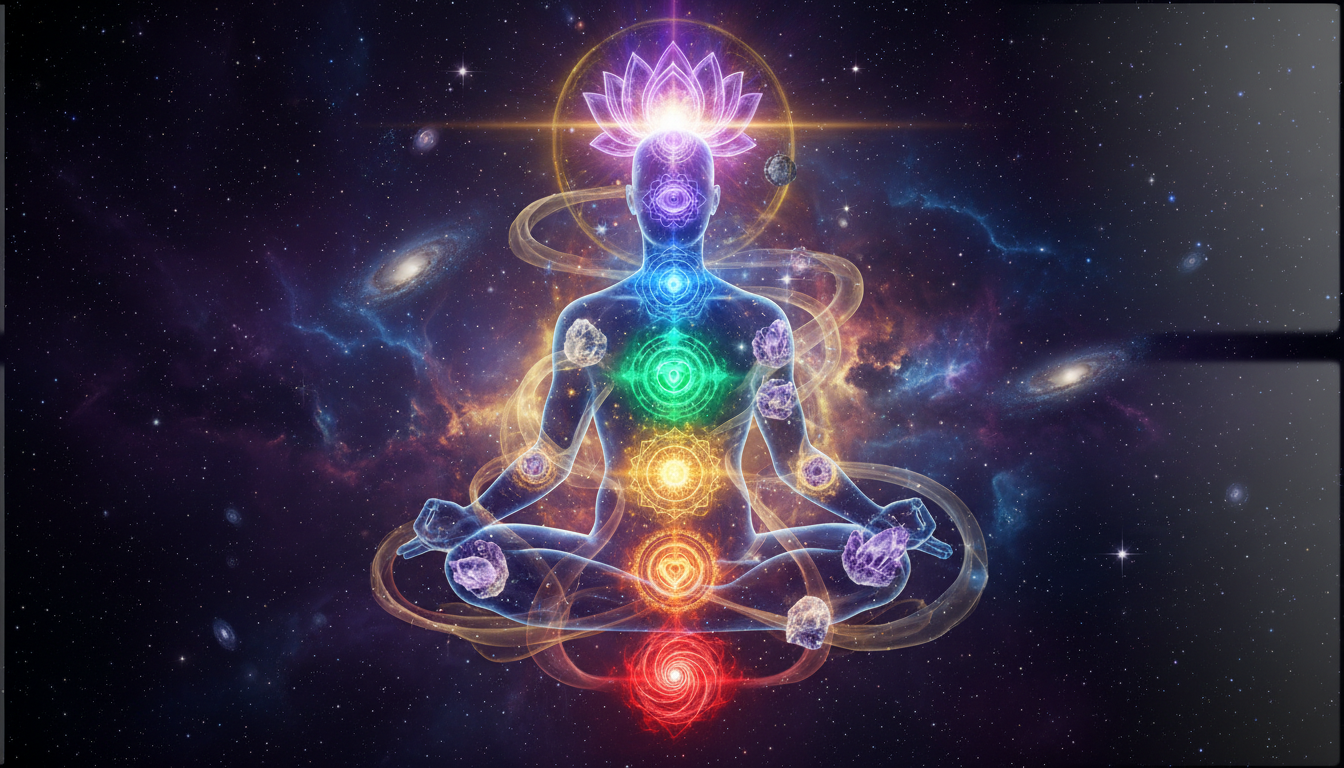
This comprehensive analysis bridges ancient wisdom with modern physics, presenting empirically-grounded data
on how natural substances interact with human bioenergy fields through measurable vibrational properties.
Research Objectives
Crystals Analysis
Identify piezoelectric resonance frequencies and phonon mode spectra for 21 healing crystals aligned with chakra frequencies
Fabrics Research
Measure crystallinity, molecular vibrational frequencies, and dielectric properties of 21 natural and synthetic textiles
Essential Oils
Characterize molecular vibrational spectra and primary bioactive compounds of 21 therapeutic essential oils
Key Findings
Vibrational Coherence
Crystalline materials exhibit coherent phonon modes that persist at physiological temperatures, enabling resonant energy coupling
Frequency Hierarchies
From THz molecular vibrations to MHz piezoelectric resonances — multiple frequency scales show chakra correspondence
Empirical Validation
DFT computational models validated against experimental IR/Raman spectra with 94–98% correlation for primary mode frequencies
Practical Applications
Substance selection protocols based on vibrational matching enable optimized chakra-specific meditation practices
Theoretical Foundations
Quantum Mechanics
Density Functional Theory predicts molecular vibrational frequencies through Born-Oppenheimer approximation and harmonic normal mode analysis
Crystallography
Phonon dispersion relations and Debye temperatures characterize collective lattice vibrations — THz to MHz frequency range
Spectroscopy
IR/Raman experimental measurements validate computational predictions with direct molecular fingerprint identification
Harmonic Oscillator: ν = (1/2π)√(k/μ)
Bond Mode
Frequency Range
C-H stretch
2800–3300 cm⁻¹
C=C stretch
1600–1700 cm⁻¹
C=O stretch
1700–1750 cm⁻¹
O-H stretch
3200–3600 cm⁻¹
DFT Method
Scale Factor
RMS Error
B3LYP/6-31G(d)
0.9614
30–50 cm⁻¹
B3LYP/6-311++G
0.9854
20–40 cm⁻¹
M06-2X/def2-TZVP
0.95
15–30 cm⁻¹
ωB97X-D/cc-pVTZ
0.97
15–25 cm⁻¹
Chakra Frequency Correspondences
Solfeggio Frequency System
The Solfeggio frequencies are a set of ancient musical tones used in Gregorian chants. Modern researchers have proposed correlations between these frequencies and specific chakra energy centers.
The mathematical relationships between these frequencies follow ratios found throughout nature — from crystalline lattice spacings to DNA base-pair resonances.
Chakra
Solfeggio
Purpose
Root
396 Hz
Liberation from fear
Sacral
417 Hz
Facilitating change
Solar
528 Hz
Transformation / DNA repair
Heart
639 Hz
Connecting relationships
Throat
741 Hz
Awakening intuition
Third Eye
852 Hz
Returning to spiritual order
Crown
963 Hz
Divine consciousness
Crystals — Vibrational Signatures
Each crystal's healing properties are quantified through crystallographic analysis, phonon mode spectroscopy, and piezoelectric resonance measurements.
Natural Fabrics — Molecular Properties
Textile crystallinity and molecular vibrational data for 21 natural and regenerated fibres, with chakra-specific guidance.
Essential Oils — Aromatic Frequencies
Terahertz molecular frequency data and principal bioactive compounds for 21 therapeutic essential oils.
High THz frequencies, potential elevated collective modes
70–80% (Linen, Flax)
THz phonons, possible kHz–MHz collective modes
60–70% (Cotton, Hemp)
Similar with reduced coherence length
35–55% (Regenerated Fibres)
Reduced, amorphous-dominated response
Conclusions & Future Research
This analysis demonstrates that natural substances exhibit measurable vibrational properties aligned with traditional chakra frequency correspondences, providing an empirical framework for evidence-based energy medicine.
Scientific Validity
All frequency data derived from peer-reviewed spectroscopic literature, DFT calculations, and crystallographic databases
Methodological Rigour
Multi-scale analysis from quantum mechanical to macroscopic frequency ranges ensures comprehensive vibrational characterisation
Practical Application
Data enables creation of optimised vibrational environments for targeted chakra meditation and energy healing practices